

Guide
Buying a portable air conditioner: PortaSplit, monoblock or split system?
You want to cool your home but are not sure which air conditioner is right? We compare the three common types – mobile splits such as the Midea PortaSplit, classic monoblock units and permanently installed split systems – so you can find the right one for your flat.
Updated 6 min readEditorial team woklima.de
The three types compared
Mobile split (e.g. Midea PortaSplit): around 3.5 kW of cooling, indoor unit about 39 dB in silent mode, no installation, portable, energy class A++/A+, suitable for tenants, guide price in the high three figures.
Monoblock: 2.6–3.5 kW, about 55–65 dB, no installation, portable, energy class A/A+, suitable for tenants, guide price in the mid to high three figures.
Permanently installed split system: 2.5–7 kW, 20–40 dB indoors, installed by a specialist, not portable, energy class A++/A+++, for tenants usually only with the landlord's consent, four-figure price plus installation.
What to look for when buying
Cooling capacity must match the room size: roughly 60–100 W per m² – 12,000 BTU (3.5 kW) covers about 35–45 m². In a mobile split the compressor sits in the indoor unit and can hum; only the hot condenser unit stands outside. Even so, it is usually quieter than a monoblock, which keeps all the waste heat inside the room.
- Efficiency (SEER/energy class): a higher class noticeably cuts electricity costs over the summer
- Exhaust and setup: a monoblock needs a hose in the window, a mobile split a small outdoor unit
- Tenants: portable units need no structural changes – ideal without landlord consent
- Refrigerant: new units increasingly use R290 (propane) – climate-friendly and future-proof
Mobile split units in our catalogue
Ad All products linked with "View offer" are commission (affiliate) links: if you buy through them, we earn a commission – the price stays the same for you. As an Amazon Associate and eBay Partner Network affiliate we earn from qualifying purchases. Learn more
 Ad
Ad Ad
AdMidea Portasplit Mobile Air Conditioner, Cooling A++/Heating A+, 12000 BTU …
 Ad
Ad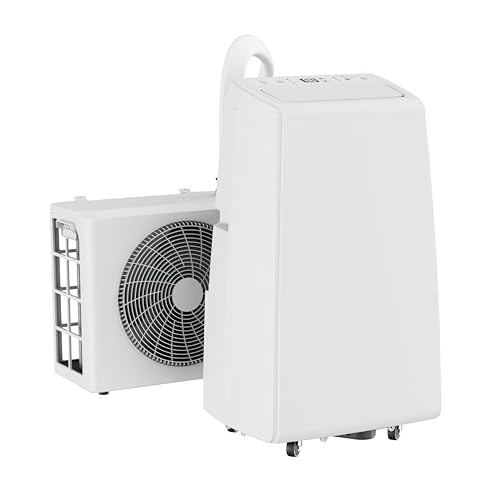 Ad−9%
Ad−9%Product prices and availability are accurate as of the date/time indicated and are subject to change.
When the PortaSplit is sold out
The Midea PortaSplit is popular and often sold out during heatwaves. On our home page you can see the live status of DIY store chains in Germany, Austria and Switzerland, plus in-store stock on the map. Proven alternatives are the Remko RKL 495 DC (a mobile split with more power) or monoblock units from Comfee and De'Longhi.
Monoblock alternatives
Ad All products linked with "View offer" are commission (affiliate) links: if you buy through them, we earn a commission – the price stays the same for you. As an Amazon Associate and eBay Partner Network affiliate we earn from qualifying purchases. Learn more
 Ad
Ad Ad
Ad Ad
AdMonoblock Air Conditioner
 Ad
AdAir Conditioner Sinclair 2.7 kW Monoblock Window ASW 09BI R32
Working out room size and cooling capacity
The rule of thumb of 60–100 W per square metre is a starting point, not a law. Use the upper value if the room is under the roof, has large south- or west-facing windows, holds a lot of equipment or people, or has a ceiling higher than 2.60 m. The lower value is enough in well-insulated new buildings with external blinds. So a 20 m² ground-floor bedroom needs about 1.5 kW (5,000 BTU), while a 35 m² living room under the roof needs more like 3.5 kW (12,000 BTU).
Too little capacity is the most expensive mistake: the unit runs at full load constantly, gets loud, uses a lot of power and never reaches the target temperature on hot days. Slightly too much capacity, on the other hand, does little harm – modern units cycle or throttle down. If in doubt, go one class bigger.
Noise: what the numbers mean
Manufacturers usually state the sound power level according to EU regulations – that is the total energy radiated, not what you hear two metres away. The sound pressure level at your ear is typically 8–10 dB lower. Figures are only comparable when measured the same way, so read the small print. As a guide: 40 dB is a quiet library, 50 dB a quiet conversation, 60 dB a conversation at normal indoor volume.
For bedrooms, what counts is the night-mode figure, not the best value on the spec sheet. Monoblocks are usually at 48–55 dB there, the PortaSplit at about 39 dB in silent mode. If you are very sensitive to noise, cool the room before bedtime and then switch off – or choose an inverter unit that keeps running quietly instead of audibly switching on and off.
Refrigerant, energy label and future-proofing
The energy label for portable air conditioners ranges from A+++ to D; the key figure is the EER (Energy Efficiency Ratio): cooling output divided by power input. An EER of 2.6 corresponds to class A, from about 3.1 you get A+. Mobile splits achieve A++ and better because the waste heat stays outside. Over a summer, a better EER can easily make a 20–30% difference in electricity costs.
R290 (propane) has become the standard refrigerant: climate-friendly, efficient and effectively mandatory for monoblocks since 2025 under the EU F-gas rules. Older units with R410A or R32 are not banned, but are harder to repair when they fail because refrigeration technicians increasingly avoid the old refrigerants. If you are buying new, go for R290 – or, with the PortaSplit, wait for the 2027 generation, which also switches to propane.
Setup and windows
A monoblock is best placed right by the window with a short, straight hose; every metre of hose and every bend costs output because the hot hose radiates heat back into the room. A fabric window seal (tilt windows) or a sealing panel (sliding and casement windows) stops warm air from flowing back in – without a seal, a third of the cooling capacity is wasted. With a mobile split, the outdoor unit hangs on the windowsill or stands on the balcony; it needs shade and free air circulation, and the flat line fits through the tilted window sash.
- Tilt window: fabric seal with a zip, attached with hook-and-loop tape
- Sliding window/balcony door: plastic or aluminium sealing panel, adjustable in width
- Roof window: special roof-window kits, otherwise seal with foam wedges
- Condensate: route the drain of a mobile split outside, keep an eye on the tank of a monoblock
Our recommendation by situation
Three questions decide it: how many days a year do you really need cooling? Should the unit run in the bedroom at night? Will you still live in this flat in two years? Answer honestly and you will almost always end up with one clear type of unit – and avoid the bad buy that ends up in the cellar:
- One room, few hot days a year, small budget: monoblock with 9,000–12,000 BTU and night mode
- Regular use, bedroom or home office, rented flat: mobile split (Midea PortaSplit)
- Large rooms from 45 m² without installation: Remko RKL 495 DC or two units
- Own property, several rooms, long-term: permanently installed split or multi-split system from a specialist
- Heating in spring and autumn too: model with heat pump function (4-in-1), ideally a mobile split
FAQ
What is the difference between a monoblock and a mobile split?
A monoblock stands entirely inside the room and sends warm air outside through a hose. A mobile split has a small outdoor unit – which makes it quieter and more efficient, but somewhat more expensive.
How many BTU do I need?
For 35–45 m², 12,000 BTU (3.5 kW) is typical. Smaller rooms manage with 9,000 BTU; very large or sunny rooms need more.
Can I use an air conditioner as a tenant?
Portable units (monoblock or mobile split) need no structural changes and can be used without the landlord's consent. Permanently installed split systems usually cannot.